Author: andrey
Project Overview
SFV Auto Parts is a customer‑first auto parts store dedicated to helping drivers, DIYers, and shops find the right parts at the right price.
Challenges
When SFV Auto Parts approached us, their Google Shopping setup was significantly underperforming and lacked the structure required to scale profitably. The account was generating a ROAS of only around 150%, which was far below the client’s profitability target, considering their break-even ROAS ranged between 300–350%.
The client’s primary objective was to scale ad spend to approximately $8,000/month while maintaining a ROAS above 400%, which required a complete rebuild of both the account structure and the underlying tracking ecosystem.
Solution
- Advanced Product Feed Optimization
We optimized the Merchant Center feed using automated rules for price ranges, product categories, best sellers, and inventory levels, enabling better campaign segmentation and Shopping visibility.
- Complete Google Ads Account Restructure
We rebuilt the account structure based on historical performance data, separating branded campaigns, launching segmented Standard Shopping campaigns, and improving P-Max query control.
- Custom dataLayer & Dynamic Remarketing
We implemented a custom eCommerce dataLayer with proper shopping events and product IDs, enabling accurate conversion tracking and dynamic remarketing campaigns.
Results
- ROAS Improvement
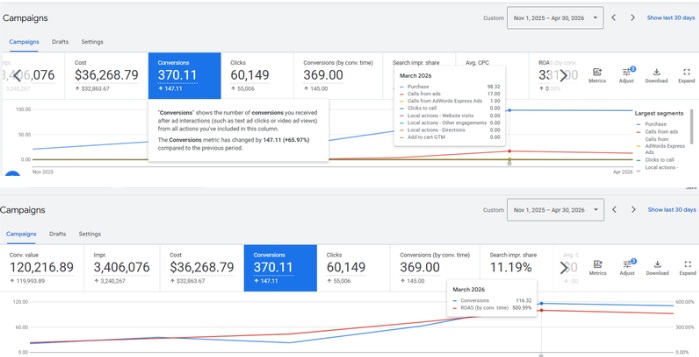
After taking over the account in February, we increased ROAS to around 500%, achieving over 3x improvement compared to the previous period.
- Accurate Tracking
Implementing a proper eCommerce dataLayer improved conversion accuracy and enabled fully functional dynamic remarketing campaigns.
- Conversion Growth
Purchase conversions increased from 21 in November 2025 to over 110 in April 2026, marking nearly 5x growth.
Just some larger text first
There are some words in this paragraph repeasted multiple times. There are some words in this paragraph repeasted multiple times. There are some words in this paragraph repeasted multiple times. There are some words in this paragraph repeasted multiple times.

And a randomly added image above.
Here we go..
Project overview
LitterBins is a UK based company with over 20 years of experience supplying and manufacturing bins to domestic, trade and public sectors.
Challenges
The client wanted to use Shopping placements to promote B2B-type products and also increase their presence in Free Listings. The products from Shopify were imported via the native Google & YouTube app without any additional changes to the attributes. The current campaigns targeted all the products without segmentation. For Shopping, the client used a PMax campaign, primarily focused on acquiring traffic for low-priced products. High Average Order Value could lead to the situation where the client could receive 1-2 purchases monthly which cover monthly costs.
Solution
- Conversion tracking with 1 Symprosys
The number of purchases was mismatched with the data we saw in Shopify using UTM parameters, so we switched to custom pixel tracking provided by Simprosys.
- Add to cart conversion
With 1-2 purchases monthly tROAS smart strategies weren’t available for Shopping campaigns, so we added add to cart conversion with a lower Conv. value to provide more signal to Google
- Shopping query filtering system
To focus only on the most relevant queries we created three campaigns with a shared budget, different bids (using tROAS), and priorities to bid more on the most relevant keywords.
- Feed Optimization
Using Simprosys and Supplemental feed we filled empty attributes and prepared well SEO optimized titles.
- tROAS adjustments, Product and Search Term research
To ensure profitability, we regularly updated the product list, making sure to showcase only bestsellers. We also adjusted semantics to target the most relevant keywords and modified tROAS targets when we had the capacity to scale or needed to maintain profitability.
Results
- Scaled Campaigns – We increased monthly spending 4x with a stable ROAS over 333%
- Increased quantity of purchases – 1-2 Purchases increased to 10-20 purchases monthly with high AOV
- B2B oriented setup – Instead of targeting low-priced products with generic keywords, we target B2B oriented bins with high intent keywords.
Project overview
StencilsMoney is an e-commerce project with a lead generation-focused product selling laser-cut stencils that is customizable for each client.
Challenges
The account was set up by the client with the help of a Google Rep—essential setup with PMax, broad match, and many options that offer no control without additional profit. The main focus was on shopping campaigns using PMax full-asset. At the same time, the shopping feed required adjustments for incorrect attributes, misspellings, availability issues, and images.
Solution
- Shopping Feed Optimization
Adjustments to titles and descriptions to align with search terms and key benefits. Promotions and delivery descriptions were also excluded. Availability was corrected (changing “in stock” to “preorder” with a scheduled update), along with sizes.
- Campaigns segmented by Geo
We noticed that smaller cities generate more revenue compared to major cities like New York. We segmented campaigns into three sets of cities with different ROAS targets, ranging from low to high.
- Conversions adjustments
We added a fixed conversion value for “Add to Cart” to use alongside purchases, ensuring that revenue numbers are not inflated when a purchase hasn’t actually occurred. Additionally, we excluded extra purchases from Primary conversions to prevent duplicate conversions.
- Focus on search campaigns
We added a fixed conversion value for “Add to Cart” to use alongside purchases, ensuring that revenue numbers are not inflated when a purchase hasn’t actually occurred. Additionally, we excluded extra purchases from Primary conversions to prevent duplicate conversions.
- Ad Group tROAS adjustments
We have approximately 6,000 keywords with applied ad customizers allocated to different semantic groups. Despite our primary source being the term “custom stencils,” we have established a strong semantic core using the most relevant headlines, eliminating the need for daily negative keyword research to exclude irrelevant terms.
Results
- 2024 vs. 2023 results – +749% Revenue from Paid Channels, +$150,000 from Paid Channel, and +180% or +$200,000 in total revenue
- Quarterly results – Stable revenue growth of 20%, approximately $15,000 in additional revenue
- Total Control – We defined semantic, geographic, and performance patterns, which we manage through bid adjustments rather than exclusions.
Project overview
Proactive-Healthcare is an online retailer of supplements and vitamins and other health wellness products distributor based in the UK.
Challenges
Running ads for healthcare products isn’t easy. Margins are tight, competition is brutal, and strict advertising rules mean you can’t always promote your best-sellers. Proactive Healthcare was feeling all of this. Their ads were running, but the numbers weren’t working. Smart bidding was pushing CPCs too high, eating into their already slim margins. Some of their best-selling roducts kept getting disapproved, cutting off a major source of revenue. And in such a crowded market, simple campaigns just weren’t enough to break through.
Solution
- Built a solid foundation with fully functional tracking and optimized product feed.
- Addressed +700 SKUs with disapprovals due to policy restrictions, ensuring more products could be advertised.
- Analyzed backend sales data to identify and scale high-revenue products.
- Adjusted product feed to prioritize high-converting products.
- Implemented accurate tracking using Google Tag Manager and GA4 Ecommerce reporting.
- Segmented products based on past performance to optimize campaign structure.
- Removed disapproval-causing terms and refined product titles and descriptions for better search relevance.
- Started with Manual CPC to gain initial data, then transitioned to Max Conversion Value bidding.
- Shifted from P-Max to Standard Shopping Campaigns with strategic product segmentation.
Results
- 25% Conv. value increase – With more products approved, 25% more sales were registered in one calendar year.
- Disapproved Products Decreased from 63% to 18% – Including bestsellers, that helped to get more revenue from a lower cost.
- 50% Cost Decrease – Any instance of unprofitability was cut out, spend was going on products that had enough margins to be profitable, resulting in more revenue registered from lower cost.
Project overview
The StoryKeeper platform preserves stories – physically and virtually – for generations to enjoy
Challenges
The client approached us to help improve their Google Ads campaigns for the peak season from November to December. The challenge was to drive the right traffic and increase purchases during this period by leveraging previous years’ data to adjust bids efficiently. Additionally, the client wanted to launch multilingual campaigns in Italian, Spanish, French, and German to target a broader audience.
Solution
- Account Structure
We launched new search campaigns in multiple languages, ensuring the use of the right keywords, ad copies, and assets tailored to each language.
- Data Analysis
By analyzing previous years’ trends and metrics, we identified the best-performing keywords and adjusted bids accordingly to maximize returns.
- P-Max Insights
We implemented a custom P-Max script to gather insights and optimize asset groups. Additionally, we created a negative keyword list for each P-Max campaign to effectively manage and exclude irrelevant traffic.
Results
- Revenue Tripled – Compared to the previous year’s data, revenue tripled during the peak season.
- Effective Account Structure – The new account structure allowed for better optimization and performance management.
- Strong ROAS – The campaigns maintained a ROAS of around 220%, ensuring efficient ad spend and maximized profitability.